A Polity That Works for People
 Facebook
 Twitter
 Linkedin
 Google +

China’s whole-process people’s democracy has created happiness and prosperity for its citizens and promoted global peace and development.
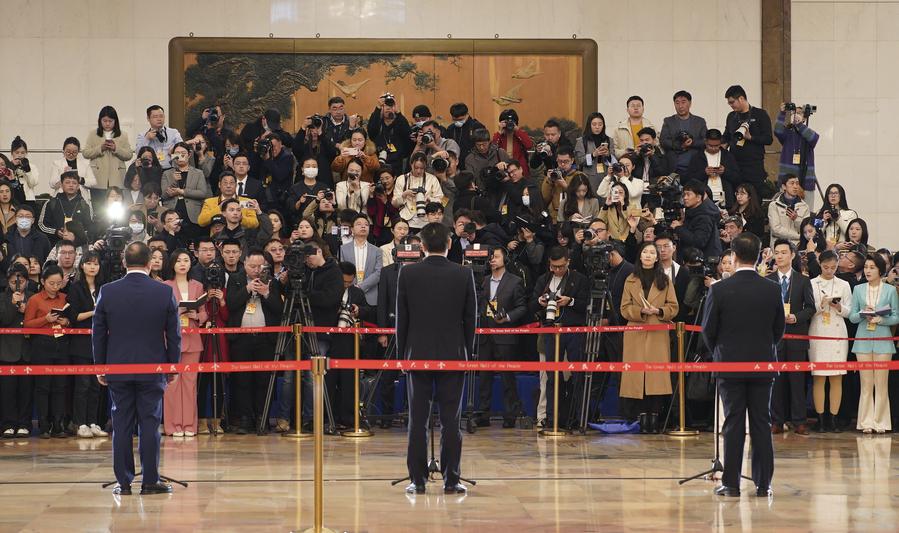
China’s Two Sessions that take place in early March provide an opportunity for the world to look into the country’s unique democracy – the whole-process people’s democracy. It is a concept that is misunderstood and wrongly criticised by most Western politicians as it differs from the Western notion of democracy.
As Zhang Weiwei, dean of the China Institute of Fudan University in Shanghai, said, China’s political system does not claim to be universal. Unlike Western democracy, it does not seek to impose itself on the rest of the world. “If [Western] democracy is the panacea of development, then why are most developing countries that opted for Western democracy still poor?” he asked.
Western democracy disregards the pluriverse and existence of other civilisations and treats multi-party systems with regular elections as key defining features, which has led to what Zhang terms a perpetual cycle of?“elect and regret,” as the governments fail to deliver tangible socio-economic benefits. Western democracy is based on the notion of?“universality,” where universality means the quest to replicate Western systems in the rest of the world and impose the West-centric vision of the world, especially in the former colonies that were deemed?“empty lands,” empty of culture, knowledge and civilisation.
How democracy works
The whole-process people’s democracy as practiced in China differs from the Western democracy primarily in its organisational structure, guiding principles and development practice. While Western democracies emphasise multi-party systems, individual freedoms, and competitive elections, China’s model focuses on collective decision-making led by the Communist Party of China, with an emphasis on both short-term and long-term social stability and economic development.
This approach appeals to the Global South due to its ability to swiftly implement policies geared towards rapid industrialisation, poverty alleviation, and infrastructure development, often bypassing lengthy political gridlock and bureaucracy prevalent in Western democracies. Additionally, China’s model is seen as more adaptable to diverse cultural and historical contexts, resonating with nations seeking alternative paths to development and governance that prioritise socio-economic progress over strict adherence to Western democratic norms.
The whole-process people’s democracy is based on Chinese wisdom that alternatives exist, that no system is either universal or tamperproof, and that countries and nations must not copy but explore the best governance systems suitable to their national conditions and aspirations of their people.
Chinese Foreign Minister Wang Yi, addressing the 14th Bali Democracy Forum in December 2021, had this to say about democracy,?“Just as plants are unique to the land they grow on, democracy, as a major fruit of human progress, is also rooted and nurtured in the history, culture, ethnic traditions and social environment of the countries concerned… There is no single correct form of democracy for others to worship, and no democracy is superior to others.”
The value of democracy is shared widely, but its practice is diversified. Democracy must put people first, and not just adhere to the?“rules of the game” which are only measured by regular elections.
China‘s whole-process people‘s democracy not only emphasises the process of legitimacy, but also the legitimacy of the results, ensures that citizens engage in every aspect of policy-making, implementation and supervision, and meets the development needs of its citizens.
Happiness for the people
Where do people derive their happiness? They do so from their socio-economic conditions and overall well-being as created by their governments. Since the launch of the UN International Day of Happiness, there is also a growing consensus about how happiness should be measured. This means national happiness can now become an operational objective for governments. Accordingly, the Chinese believe?that the objective of public policy should be measured by the happiness of the people. Chinese people’s sense of happiness keeps increasing these years. This is a great milestone given that China has emerged from being a highly impoverished and agrarian nation to a more prosperous industrialised nation leading in many fields.
The belief that happiness of countries should be a key measure is growing elsewhere as well. As scholars Timothy Besley, Joseph Marshall and Torsten Persson write in the World Happiness Report on?Well-being and State Effectiveness,?“Many observers have argued that governments should aspire to raise the happiness of their citizens. Yet, experience suggests that it is a huge challenge to orient the government towards this goal and ensure that it can effectively deliver on it. A key reason is that even benevolent-minded policymakers who would like to pursue a happiness goal may not have the capability to do so.”

This could be because most countries have forms of government which have been imposed on them. The whole-process people‘s democracy is an example of how countries and governments should strive to design governance systems that directly respond to their domestic conditions and aspirations if they are to succeed.
The effectiveness of China’s path of governance can be measured by the development achievements. The reform and opening up policy implemented since late 1978 is central to this analysis. As Chinese President Xi Jinping has said, “Without reform and opening up, China would not be what it is today, nor would it have the prospects for a brighter future.” The reform and opening-up policy meets China’s domestic aspirations and also meets the global common aspirations of cooperation, development and peace. Since its launch, China has not only realised its domestic development aspirations and needs, but also made a significant contribution to global peace and development and the building of a community of shared future for mankind.
In his writing on China’s 40 years of reform and opening up, Huang Qinguo, former Chinese ambassador to the Commonwealth of The Bahamas, summed up the achievements: “China has been a major stabiliser and driving force for the world economy. It mitigated against the Asian and global financial crises. China is the largest trading partner of more than 120 countries, contributing to the creation of millions of jobs worldwide and the creation of businesses in more than 190 countries and regions.”
On the domestic front, the policy has brought rapid economic growth, with the GDP rising 35 times and its share in the global economy moving up from 1.7 percent to more than 18 percent. ?Both China’s urban per-capita disposable income and rural per-capita net income have increased by over 100 times. Primary medical insurance and endowment insurance have covered 1.36 billion and 900 million people respectively. China has eradicated absolute poverty throughout the country by 2021.
These clearly demonstrate the success of China’s whole-process people’s democracy.
The author is?Director General of National School of Government, South Africa, and D.Phil. Research Fellow of University of Chinese Academy of Social Sciences.