Global Concerted Efforts Required to Tackle Locust Threat Before It’s Too Late
 Facebook
 Twitter
 Linkedin
 Google +

An action taken now will be much more economical for the international community than mobilizing resources after trying to wait out the crisis. A quick and generous multinational response is immediately needed as we still have a chance of defeating this scourge.
Mother Nature is making some tough calls lately. In one continent it is raging with forest fires, in another with a coronavirus and in a couple with swarms of locusts.
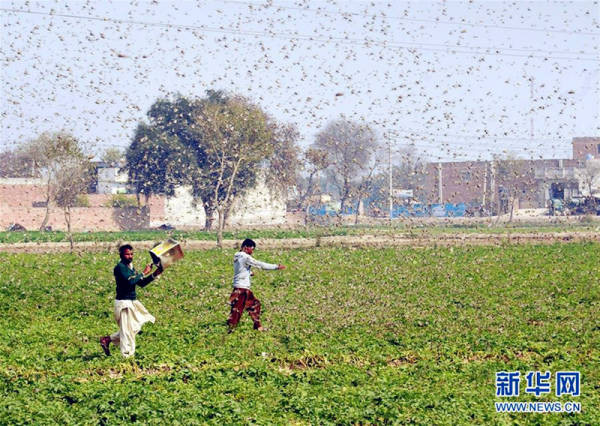
While the other calamities are somewhat under control, desert locusts are eating up crop after crop and straining the already strained food security arrangements of the affected countries. Covering nearly 16 million square kilometers as of the week before last, they are attacking grains, fodder, vegetables, and even tree barks.
The prevalent wave originated from Africa where it severely impacted eastern parts of the continent. After that, it crossed over via the Arabian Sea to Oman and further into Pakistan and India. Toward the west, it even stretched over the Persian Gulf and reached Iran.
The locust threat at the doors
The majority of the afflicted countries are developing nations with limited arrangements to meet their food demands. Many in Africa have had a history of battling famine and the ongoing locust attack is once again putting them in a difficult position. Without strong industries, they largely rely on agriculture for the livelihood of their people. With crops endangered, businesses that depend on them are facing an existential threat. These effects will then pass on to health, nutrition, and education.
This response by Mother Nature is partly owed to what we have been doing to her. As the Secretary-General of the United Nations António Guterres has warned, the locust crisis is linked to climate change. Since the world is still not doing enough to effectively cut down on emissions, seas are warming at an unprecedented pace.
The warming is not only raising sea levels but the frequency of cyclones is also increasing and inducing favorable spawning grounds for desert locusts. The European Civil Protection and Humanitarian Aid Operations (ECHO) has revealed in a situation report that the excessive breeding affecting Ethiopia, Somalia and The Red Sea is attributed to an above-average rainy season.
There are some regions around the impaired areas that are still protected. But that’s because of winters. With spring season around the corner – which creates favorable conditions for locusts – the problem is about to get worse.
The UN has forecast that by June, it can increase 500 times if left unchecked. The next cycle of rain and planting is beginning in March and concrete actions will have to be taken before that or else we risk a flurry of new swarms in Ethiopia, Somalia, and Kenya in the coming two months.
The most effective way of containing this menace is early intervention. An action taken now will be much more economical for the international community than mobilizing resources after trying to wait out the crisis. A quick and generous multinational response is immediately needed as we still have a chance of defeating this scourge.
Multinational cooperation is needed
As this has become a cross-border challenge, concerted efforts are required to tackle it. The disrupted countries need to undertake coordinated actions between government departments, carry out real-time monitoring and ensure the availability of sufficient pesticides and equipment. At the global level, governments need to exchange control information and cooperate in neutralizing the issue at its current stage.
China, in this regard, has been especially forthcoming. Chinese experts are in contact with their counterparts at the African Academy of Sciences in Kenya to chart a joint strategy. Chinese Academy of Sciences uncovered the genome of locusts in 2014 and is now studying to counter the menace through genetic means. It has customized pesticides at the genetic level and completed the editing of locusts’ genes.

The nearest that the locust wave has reached the Chinese mainland is in its western neighbor Pakistan. Surfacing after nearly 27 years, an unprecedented third generation breeding is jeopardizing cotton, maize and wheat crops there. The Pakistani government has declared a state of emergency in several districts since agricultural output forms the backbone of its national economy.
The Food and Agriculture Organisation (FAO) of the UN has assured to provide technical and strategic support and develop a roadmap for cost-effective control in Pakistan. The Pakistani government has allocated an amount of 7.2 billion rupees (around US$46 million), formed 128 teams and is using tractor-based pesticide sprays.
A more efficient way, however, is the spraying from aircraft to treat large areas quickly. Dr. Anjum Ali Babar, director-general for Agriculture Extension in the Punjab province, says that 10 to 15 aircraft are immediately required to stave off the hazard. For this purpose, Pakistan has officially requested China to provide it with airplanes. A Chinese delegation is traveling to Pakistan in the coming days to evaluate aerial management of the problem.
A creative approach that Pakistan has adopted is to buy dead locusts from farmers. The offer has received an encouraging response and people have been bringing bagfuls to authorities. Rich in protein, these locusts will be used as an ingredient in poultry and animal feeds.
After wide media coverage of the plague, Chinese netizens have been concerned about its expansion into the Chinese mainland. But authorities and field specialists believe that the risk is relatively low. Though in summer months, the probability of the wave reaching China might increase.
The high altitudes of Mount Kunlun and the Himalayas present a natural barrier to locust propagation. The threatened areas, meanwhile, are Yunnan and Tibet where locusts traditionally migrate from India and Nepal during the spring season. Moreover, Shandong province also has a favorable environment for their breeding.
China has a well-honed mechanism for locust prevention. With a four-tier monitoring and early warning system and state of the art control technology, the ravenous swarms are up for a formidable challenge. Sufficient supplies of anti-locust devices and pesticides are stocked up and residents in prone areas have adequate experience in warding them off.

Then there are some environment-friendly options as well. As news of the outbreak in Africa and South Asia spread, a three-year-old China Central Television (CCTV) documentary showing the use of chickens to control locust plagues became viral on Chinese social media. In May 2000, when the Xinjiang Uygur Autonomous Region of China faced a similar situation, 100,000 ducks also joined the fight. Within three to four months, they had cleared an area of one million acres.
Like other natural calamities, the locust onslaught is a serious issue. Now that it is affecting multiple countries, and particularly those that cannot cope up with the predicament on their own, there is a dire need of launching collaborative efforts to nip the evil in the bud. More delay, more cost. We have no time to lose to address its impacts.
Iram Khan is a Pakistan-based commentator on international and commercial affairs.