Regional Ethnic Autonomy in Xinjiang
 Facebook
 Twitter
 Linkedin
 Google +

The great changes of Xinjiang over the past 70 years show that the system of regional ethnic autonomy respects history, conforms to national conditions, and meets the aspirations of the people, thus having tremendous advantages and strong vitality.
On October 1, 1955, the sixth anniversary of the founding of the People’s Republic of China, the Xinjiang Uygur Autonomous Region was proclaimed. This was an epoch-making event in Xinjiang’s history, opening a new chapter in its development and initiating an important journey toward prosperity and progress.
Over 70 years of strenuous effort, Xinjiang has undergone impressive transformations: from poverty to affluence, from isolation to openness, and from backwardness to prosperity. These 70 years, marked by solid strides and remarkable achievements, have vividly demonstrated the distinct advantages and strong vitality of the system of regional ethnic autonomy. The efforts have proven to the world that this system respects history, conforms to national conditions, and meets the aspirations of the people, as well as being a significant advantage of the system of socialism with Chinese characteristics.
Historical choice
Since ancient times, Xinjiang has been a region jointly developed and inhabited by multiple Chinese ethnic groups. In 60 B.C., the Western Han Dynasty (206 B.C.-24 A.D.) established the Western Regions Frontier Command in Wulei (present-day Luntai County) to exercise unified jurisdiction over the Western Regions, marking Xinjiang’s official incorporation into China’s territory. Throughout the following centuries, various ethnic groups in this vast land have engaged in exchanges and lived side by side, forming a close bond. During modern times, in the face of imperialist aggression and sabotage by separatist forces, people of all ethnic groups in Xinjiang, together with the rest of the Chinese people, have waged an unyielding and heroic struggle to safeguard national unity and territorial integrity, making indelible contributions to the independence and liberation of the Chinese nation.?
In September 1949, Xinjiang was peacefully liberated, and its history turned a new page. On August 22, 1952, in accordance with the Outline for the Implementation of Regional Ethnic Autonomy of the People’s Republic of China promulgated by the Central People’s Government, Xinjiang held the Second Session of the First Regional People’s Congress, which adopted the Resolution on Implementing the Outline for the Implementation of Regional Ethnic Autonomy of the People’s Republic of China, and decided to establish a preparatory committee for regional ethnic autonomy in Xinjiang. On December 22, 1953, the Government Administration Council of the Central People’s Government approved the Measures for the Implementation of Regional Ethnic Autonomy in Xinjiang Province, and the preparation work for the establishment of autonomous areas in Xinjiang began. Through intense effort, by the end of 1954, Xinjiang had successively established five autonomous prefectures, including the Ili Kazakh Autonomous Prefecture, and six autonomous counties, such as the Yanqi Hui Autonomous County, completing the preparation work for autonomous areas at and below the prefecture level. On this basis, the Xinjiang Uygur Autonomous Region was formally established on October 1, 1955.
The system a country adopts to address ethnic issues is determined by its historical and cultural traditions, as well as its actual national conditions. The Chinese government’s implementation of the system of regional ethnic autonomy in Xinjiang is the result of adapting Marxist ethnic theory with China’s specific ethnic realities. It also represents adherence to China’s historical and cultural traditions, a profound understanding of national and regional conditions, and full respect for the will of the people.
From a historical perspective, as early as the Qin and Han dynasties?(221 B.C.-220 A.D.), China had already formed a political tradition of national unification. Unity has always been the backbone of China’s history, while separatism has been broadly opposed by the people. The principle of “enhancing education without changing their customs, and applying uniform rules without altering local practices” has always been the administrative approach adopted by successive central governments toward ethnic minority areas, serving as the historical foundation of the system of regional ethnic autonomy. From a practical standpoint, after long-term exchanges and interactions, various ethnic groups have become deeply integrated and inseparable. This determines that China must proceed from its actual conditions to implement the regional ethnic autonomy system, rather than copy the practices of other countries.

The Law of the People’s Republic of China on Regional Ethnic Autonomy stipulates that ethnic autonomous areas have the power to formulate autonomous regulations and specific regulations. Over the past 70 years, Xinjiang has formulated 874 local regulations, regulatory resolutions, and decisions, among which 175 are currently in effect, covering fields such as the economy, culture, education, and health, providing a solid legal guarantee for the development of various undertakings.?
Xinjiang is an autonomous region with a complete three-level structure (region, prefecture, and county). Currently, it has five autonomous prefectures and six autonomous counties, enjoying extensive autonomy in accordance with the law. In the standing committees of the people’s congresses of all these autonomous areas, citizens of the ethnic groups exercising regional autonomy hold the position of chairperson or deputy chairperson; the heads of the autonomous region, as well as its autonomous prefectures and autonomous counties are also citizens of the ethnic groups exercising regional autonomy.?
People of all ethnic groups enjoy equal legal status, the right to vote, and the right to stand for election as granted by the Constitution and laws. They also enjoy other rights, including participating in the management of state affairs, freedom of religious belief, access to education, the use and development of their own spoken and written languages, and the inheritance and protection of their traditional cultures. This institutional arrangement not only upholds the centralized and unified leadership of the central government and the smooth implementation of state policies, but also fully guarantees the rights of all ethnic groups in Xinjiang to handle their own affairs and participate in the management of state affairs, realizing the organic integration of unification and autonomy.
From wilderness to prosperity
Over the past 70 years, under China’s ethnic policies, Xinjiang has achieved a historic leap from extreme poverty, to prosperity. Every achievement bears witness to the great strength of the system of regional ethnic autonomy.
Xinjiang’s GDP was only RMB 1.23 billion in 1955, with no industrial system. In 2024, it exceeded the RMB 2 trillion mark. The per capita regional GDP increased from RMB 241 in 1955 to RMB 78,660. And the per capita disposable incomes of urban and rural residents reached RMB 42,820 and RMB 19,427 respectively. Local people’s living standards have improved significantly. ?????
In 1952, the length of paved roads open to traffic in Xinjiang was only 33,000 kilometers, most of which were simple gravel roads. Today, the operating reach of railways has hit 9,202 kilometers, connecting all prefectures and cities in the region and covering more than 80 percent of county-level administrative regions; highways extend to 230,000 kilometers, covering all prefectures and cities and over 90 percent of counties (or county-level cities and urban districts); there are 595 civil aviation routes, including 25 international passenger routes flying to 17 countries and regions. Meanwhile, the power transmission from Xinjiang to other provinces has exceeded 100 billion kWh for five consecutive years, lighting up 22 provinces, autonomous regions, and municipalities across the country. The “information superhighway” is also expanding in Xinjiang, with the length of optical cable lines reaching 1.78 million kilometers, realizing gigabit network coverage in all counties, 5G coverage in all townships, and broadband coverage in all villages.?
In 1955, agriculture and animal husbandry accounted for more than 60 percent of Xinjiang’s economic aggregate, and modern industry was almost non-existent. Today, the ration of the primary, secondary and tertiary industries is 12.5:39.6:47.9, forming three trillion-yuan industrial clusters in oil and gas production and processing, coal, coal-fired power, and coal chemical industry, as well as new energy and new materials. The output of oil and gas has ranked among the top in the country for 30 consecutive years, while the new energy industry has an installed capacity exceeding 100 million kilowatts. Annual production capacity of new energy vehicles in Urumqi, Changji, and other areas has exceeded 500,000 units, and a thriving digital economy has developed from scratch, with the output value of the IT sector exceeding RMB 150 billion yuan in 2024. E-commerce has also made a big impact, helping 100,000 farmers increase their income through online platforms in industrial parks at Kashgar and Hotan.
The construction of the core area of the Silk Road Economic Belt has further shaped a new pattern of high-level opening-up for Xinjiang. From only a few trade points on the border with the Soviet Union in 1955 to 19 open ports today, Xinjiang has opened 119 bilateral international road transportation routes and 10 multilateral international road freight routes. In 2024, China-Europe (Asia) freight trains made 16,400 trips through Xinjiang, maintaining a volume of over 10,000 for five consecutive years. The scale of foreign trade has continued to rise, with the total import and export volume exceeding RMB 430 billion in 2024.

International cooperation in culture, education, medical care, and other fields has also increased. Xinjiang Medical University has established five overseas medical centers with Kazakhstan, Kyrgyzstan, and other countries, providing medical services to more than 100,000 people in neighboring countries every year. In addition, the international communication campaign “Xinjiang is a Good Place” has been introduced into more than 50 countries, allowing the world to see an open, inclusive, and vibrant Xinjiang.
Journey to a happy life
Economic take-off has transformed Xinjiang from a “remote border area” into an “open frontier” and ensured that the fruits of development benefit all the people of Xinjiang.
The problem of absolute poverty has been resolved. By the end of 2020, all 3.06 million rural poor people in Xinjiang had been lifted out of poverty, 3,666 poor villages had been removed from the poverty list, and 35 poor counties had been delisted. Xinjiang, together with the rest of the country, has built a moderately prosperous society in all respects. Infrastructure conditions in former poverty-stricken areas have been significantly improved. All townships and administrative villages with the necessary conditions have 100 percent access to paved roads, buses, and electricity. The history of rural poor people living in dilapidated houses and drinking bitter and salty water is a thing of the past.?
Education has also achieved all-round development. More than 70 years ago, the enrollment rate of school-age children in Xinjiang was less than 20 percent. Today, the retention rate of nine-year compulsory education has exceeded 99 percent, and the gross enrollment rate of senior high school education has reached 97.74 percent, all higher than the national average. In southern Xinjiang’s Aksu, Kashgar, Hotan, and Kizilsu, 15-year free education from kindergarten to senior high school is implemented. The layout and structure of higher education have been continuously optimized. In 2024, there were 63 regular institutions of higher education in Xinjiang, and the five prefectures in southern Xinjiang have achieved the historic breakthrough of full coverage of undergraduate education. The scale of vocational education has further expanded, with the number of students reaching 575,000 in 2024, an increase of 60.69 percent compared with 2012. A large number of high-quality technical and skilled personnel have been cultivated, and a modern vocational education system has been established.?
In the past, there was a dire shortage of medical personnel and medicines in Xinjiang’s agricultural and pastoral areas, and endemic diseases were rampant. Today, the three-tier medical and health service network at the county, township, and village levels has achieved full coverage. Farmers and herders enjoy free basic public health services. Endemic diseases such as echinococcosis (hydatid disease) and tuberculosis have been effectively controlled. The average life expectancy has increased from 30 years in 1949 to 77 years in 2024.?
In the past decade, Xinjiang has built more than two million affordable rural houses and over 1.5 million affordable urban homes, allowing more than 10 million people of all ethnic groups to move into safe and comfortable new homes. In Wushi County, Aksu Prefecture, the Kirghiz people, who once lived in underground shelters in the river valley, now live in affordable houses with running water, electricity, and heating. The elderly have unanimously agreed that their new houses are much warmer than their previous yurts.
Rapid economic development and continuous improvement of people’s livelihood have continuously led to the sustained growth of the population of all ethnic groups. Xinjiang’s population increased from 4.78 million in 1953 to 25.85 million in 2020, among which the population of ethnic minorities grew from 4.45 million to 14.93 million.
Coexistence and cultural co-prosperity
Since ancient times, Xinjiang has been an area inhabited by multiple ethnic groups and a meeting place of diverse cultures. Over the past 70 years, the Chinese government has attached great importance to the protection and development of Xinjiang’s culture, and has adopted a series of policies and measures to protect the fine traditional cultures of all ethnic groups and promote cultural exchanges and mutual learning among them.
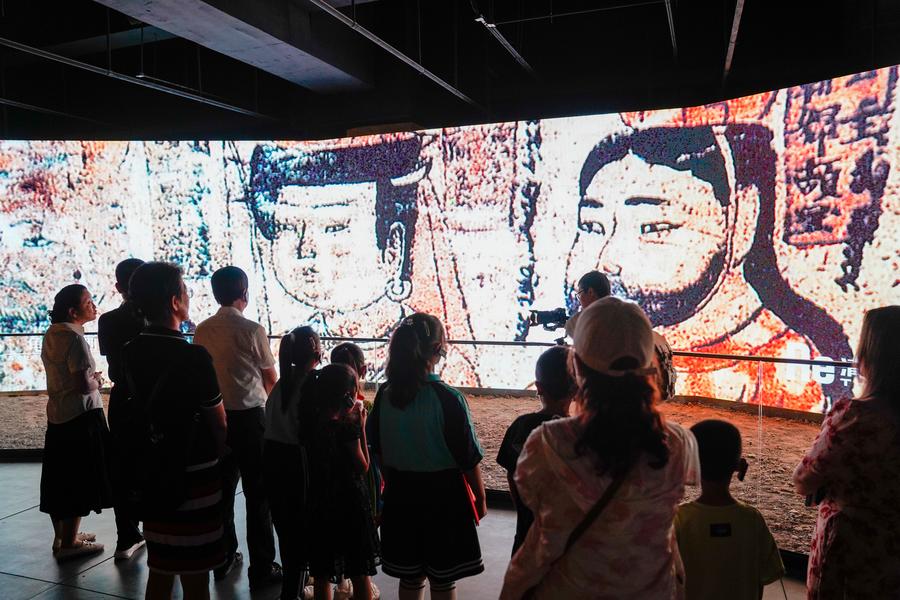
The spoken and written languages of all ethnic groups have been fully respected and protected. The Constitution of China stipulates that all ethnic groups have the freedom to use and develop their own spoken and written languages. In Xinjiang, ethnic minority languages are widely used in education, press and publishing, radio, film and television, and public services. Xinjiang has published a large number of books, newspapers, periodicals, audio, and video products in ethnic minority languages, and established databases and websites in ethnic minority languages, providing convenience for ethnic minority people to access information and inherit their cultures. In judicial, administrative, and other fields, the rights of all ethnic groups to use their own spoken and written languages in litigation and participation in government affairs are protected in accordance with the law. Government departments at all levels are equipped with translators of ethnic minority languages to ensure that policies are accurately conveyed to people of all ethnic groups.?
Cultural heritage has also been effectively protected. Xinjiang adheres to the principles of prioritizing protection, making rational use, and minimizing intervention to comprehensively enhance the protection and inheritance of cultural heritage. It has formulated plans for the protection of Xinjiang’s cultural heritage, and has successively issued local regulations such as the Regulations on the Protection of the Ancient City of Kashgar and the Regulations on the Protection of the Intangible Cultural Heritage of Manas. As of 2024, Xinjiang had six world cultural heritage sites, three intangible cultural heritage items inscribed on UNESCO’s lists, 141 items on the national intangible cultural heritage representative list, and 567 items on the regional intangible cultural heritage representative list.?
The government has specially established Muqam inheritance centers and integrated the art into music education in primary and secondary schools. Today, in the streets and cultural squares of Xinjiang, intangible cultural heritage performances organized spontaneously by people of all ethnic groups can be seen everywhere. The melodies of hand drums and tanbur (a traditional stringed instrument) interweave with cheerful dances, becoming a normal part of Xinjiang’s cultural life.?
Great efforts have been made to promote cultural exchanges among all ethnic groups. Xinjiang frequently holds events such as the China-Eurasia Expo, the Xinjiang International Ethnic Dance Festival, and the Nadam Fair, providing platforms for promoting cultural exchanges among various ethnic groups. At these events, the Han people’s yangge dance, the Hui people’s hua’er (a form of folk song), the ethnic Mongolian people’s matouqin (a horsehead fiddle), the Uygur people’s maxrap (a traditional folk gathering with music and dance), and the ethnic Tajik people’s eagle dance appear on the same stage. People of all ethnic groups learn from and draw on each other while sharing the best of their traditional art.
United as one family
In Xinjiang, a saying is widely heard: “All ethnic groups should embrace each other tightly like the seeds of a pomegranate.” Over the past 70 years, Xinjiang has always safeguarded the equality of all ethnic groups, protected the legitimate rights and interests of all ethnic groups in accordance with the law, promoted harmonious coexistence, mutual support, and coordinated development among all ethnic groups.
In Qapqal Xibe Autonomous County of Ili Kazakh Autonomous Prefecture, there is an “Ethnic Unity Complex” where 12 households of four ethnic groups — Xibe, Han, Uygur, and Kazakh — live. The “Love Canteen” in the complex has been in operation for eight years. Whenever a family cooks, they will bring it to the canteen to share; whenever a family encounters difficulties, everyone helps to solve the problems together. Wu Guilan, a 65-year-old Xibe elder, said: “In our neighborhood, Han people teach Uygur neighbors to grow vegetables, Kazakh youth help Xibe elders repair home appliances, and children go to school and play together. There is no distinction between us at all.”?
Such heartwarming stories of kinship are found everywhere in Xinjiang. Since the launch of the “Ethnic Unity as One Family” program, more than 1.1 million officials and public institution employees in the region have paired up with over 1.6 million ethnic minority households to form kinship ties. In Hotan, Zhou Lina, a Han doctor, has rooted herself in the border area for 20 years, treating and saving Uygur people. In Altay, Bahet Mhamatbai, a Kazakh herdsman has escorted Han students across a river to school for 20 years, and is affectionately called the “Protector on the Grassland” by the children.

Unity brings stability, and stability promotes development. For a period in the past, ethnic separatists, religious extremists, and violent terrorists in Xinjiang carried out rampant sabotage activities, causing huge damage to the lives and property of people of all ethnic groups and seriously undermining ethnic unity and social stability. Xinjiang has cracked down on these crimes in accordance with the law, completely reversing the situation. Today’s Xinjiang is filled with peace and joy. In 2024, Xinjiang attracted more than 300 million domestic and foreign tourists, setting a new historical record. This peace and harmony are the result of the joint efforts of people of all ethnic groups and has become a precious asset for Xinjiang’s development.
In the Urumqi International Grand Bazaar, multilingual merchants of different ethnic groups communicate for business, Han customers buy Uygur traditional handicrafts, and ethnic Kazakh herders learn cooking skills from Hui neighbors. This mixed community environment and social structure enable all ethnic groups to continuously deepen their bonds in the process of co-residence, co-study, co-work, and co-enjoyment.?
Inspiration for the rest of the world
The great changes of Xinjiang over the past 70 years show that the system of regional ethnic autonomy respects history, conforms to national conditions, and meets the aspirations of the people, thus having tremendous advantages and strong vitality.
This system is conducive to combining the centralization and unification of the country with the autonomy and equality of all ethnic groups, and is an important foundation for safeguarding national unity and stability. It is conducive to closely integrating the major policies of the state with the specific realities and circumstances of ethnic autonomous areas, and is important approach to protecting the legitimate rights and interests of ethnic minorities. It is conducive to combining the leadership and assistance of higher-level state organs with the self-reliance and hard work of ethnic autonomous areas, and is an important guarantee for accelerating the development of ethnic minorities and ethnic regions. It is conducive to combining the prosperity, democracy, civilization, and harmony of the country with the prosperity, development, progress, and harmony of all ethnic groups, and is an important prerequisite for realizing the common prosperity of all ethnic groups. The implementation of the regional ethnic autonomy system enables all ethnic groups to live in harmony, support each other, and develop together in the big family of the unified motherland, while at the same time each getting its due, doing its best, and displaying its strengths.?
Promoting the common development of all ethnic groups is where the strong vitality of this system lies. Over the past 70 years, the Chinese government has always attached great importance to Xinjiang and cared deeply for the people of this region. It has continuously supported its economic and social development by increasing financial transfer payments, organizing paired support, and implementing the Western Development Strategy. Over the past 70 years, the central government has allocated more than RMB 66.6 trillion in various transfer payments to Xinjiang. Central Party and state organs, central enterprises, and relevant provinces and cities have provided assistance in terms of talents, industrial projects, science and technology, education, medical and health care, culture, and tourism. Since 2012, more than RMB 200 billion in aid funds to Xinjiang has been arranged, the investment of economic cooperation projects has reached RMB 3 trillion, and more than 15,000 enterprises set up operations in the region. Such support and assistance are a strong driving force for Xinjiang’s leapfrog economic and social development and continuous progress.
In today’s world, against the backdrop that some countries frequently suffer from separatist activities triggered by ethnic conflicts, Xinjiang’s experience shows that to solve ethnic issues, we must respect the country’s historical and cultural traditions, stay grounded in specific national conditions, and not only safeguard the equal rights of ethnic groups but also maintain national unity and stability. We must take development as the top priority, let people of all ethnic groups share the fruits of development, and lay a solid material foundation for ethnic unity and social stability. We must promote cultural exchanges and mutual learning, not only enhance commonalities but also respect and tolerate differences, so as to gather maximum strength from all sides.?
Looking back at the past 70 years, Xinjiang has successfully implemented the system of regional ethnic autonomy and shown the world China’s wisdom in handling ethnic issues —- ensuring equality through institutional design, promoting unity through development, uniting people by safeguarding and improving their livelihood, and enhancing shared identity through culture. This is not only China’s successful experience but also contributes Chinese wisdom and Chinese solutions to the international community in solving ethnic issues and achieving common development.
Facing the future, under the strong leadership of the Communist Party of China, people of all ethnic groups in Xinjiang will take forging a strong sense of community for the Chinese nation as their focus, further uphold and improve the system of regional ethnic autonomy, work together in unity for common prosperity and development, and continue their journey of building a strong country and realizing national rejuvenation.
Wang Hongxiao?is vice President of North Minzu University, and dean of the School of the Chinese Nation Community and the Academy of the Chinese Nation Community.