Will Japan Be East Asia’s Version of Ukraine?
 Facebook
 Twitter
 Linkedin
 Google +

Japan joins U.S.-driven strategy for China containment.
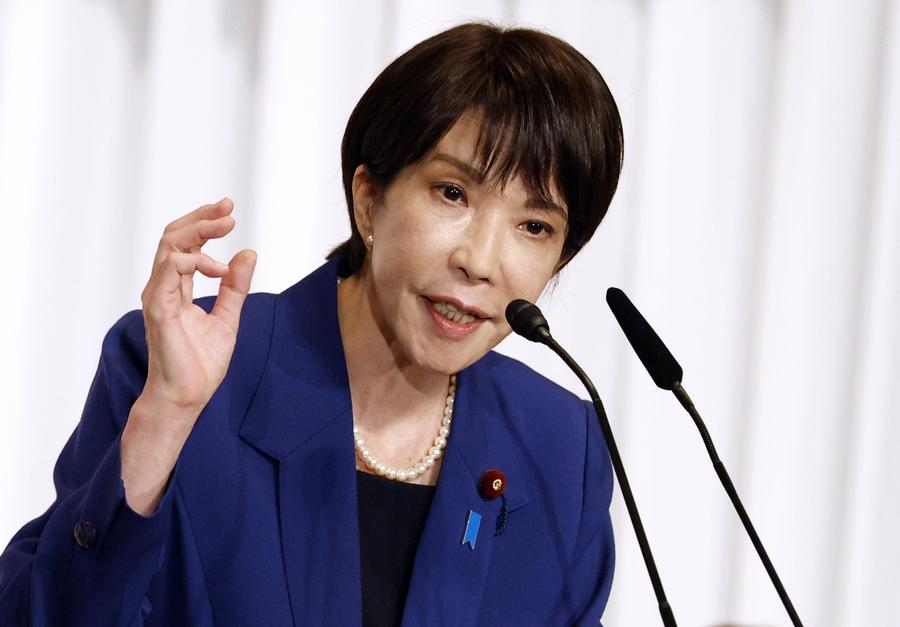
The recent diplomatic crisis sparked by Japanese Prime Minister Sanae Takaichi’s comments over Taiwan is not an isolated or spontaneous incident. It is a calculated step in a broader, ongoing strategy by the U.S. and its client states toward confrontation with China, a strategy mirroring that which the U.S. has likewise created to confront Russia through Ukraine and increasingly the rest of Europe.
Takaichi told Japan’s parliament in early November that, a possible attack from China’s mainland on Taiwan—which lies just 100 km from Japanese territory—would count as “a situation threatening Japan’s survival” and could trigger a military response from Tokyo, U.S. news broadcaster CNN reported.
Takaichi’s remarks come at a time when Japan has begun increasing military spending, widening cooperation with the U.S. militarily, and is even considering shifting its prohibition regarding nuclear weapons within its own territory.
Japan’s behavior as an eager U.S. proxy
The true significance of Takaichi’s statements lies in their synchronization with a radical, rapid shift in Japan’s defense and security policy—a policy that has been imposed upon it by the U.S. in the same manner it has been imposed on both Ukraine and the rest of Europe vis-à-vis Russia, as laid out by U.S. “Secretary of War” Pete Hegseth in a February 2025 directive delivered to Europe in Brussels.
For Japan in particular, this means transitioning away from its post-World War II pacifism into a formidable, offensively capable regional military power serving as a component of the U.S.’ containment architecture. It is a shift a previously neutral Ukraine has already made with catastrophic consequences for both itself and the rest of Europe, and one that portends similar consequences for Japan.
In October 2025, Reuters reported that Japan’s new prime minister pledged an “early boost to defense spending” with a “proactive” fiscal policy. This was quantified when DW reported in the same month that Takaichi was targeting a 2-percent military spending of GDP by March 2026, aligning with NATO’s baseline spending requirements and signaling Japan’s further integration into a global U.S.-led military bloc.
It is very likely that this 2-percent increase is merely an incremental step toward much greater spending in the near future—likely to follow Europe’s now 5-percent commitment to defense spending as demanded by Hegseth in February 2025.
Japan is also shifting its views on nuclear weapons. Reuters commented that the Japanese prime minister “might seek to revise a ban on the entry of such weapons into its territory.” This again reflects similar rhetoric from Ukrainian President Volodymyr Zelensky during the 2022 Munich Security Conference in which he threatened to void the Budapest Memorandum which includes prohibitions on Ukraine acquiring nuclear weapons.
Just as Ukraine presented Russia with an escalated, even existential threat to its national security then, an increasingly aggressive Japan removing the constraints placed on it following its 14-year-long invasion of China during 1931-45 presents an escalating, even existential threat to China’s national security today.
With the U.S. imposing similar policy on the Philippines, the Republic of Korea and even on the Chinese island province of Taiwan, a united front against China is taking shape—analogous to what the U.S. has shaped NATO into and is using it for today against Russia.
Extending Russia, extending China…
Japan’s increasingly aggressive posture fits into a much wider U.S. strategy for the region, just as Ukraine’s abandonment of neutrality served a much wider U.S. strategy in Europe.
A 2019 RAND Corporation paper, titled Extending Russia, prescribed using proxies to impose conflict along Russia’s periphery in multiple locations, along with placing economic and political pressure on Russia itself, all aimed at isolating and degrading Russia, precipitating a Soviet Union-style collapse.
In a similar manner, the U.S. is preparing a regional front of proxies in Asia-Pacific to play a variety of roles in confronting and containing China across a number of locations, enhancing the U.S.’ own military presence in the region, and to provide a frontline the U.S. can support and operate safely behind during any potential conflict.
In the 2018 Naval War College paper, A Maritime Oil Blockade Against China, a plan is laid out to interdict China’s energy imports at vital chokepoints beyond the reach of most of China’s military capabilities.
The plan requires not just U.S. military forces to impose what the paper calls a “distant blockade,” but cooperation from a number of nations to help enforce the blockade and create deterrence against China’s desire to break it. A map accompanying the paper makes clear the vital role Japan (along with the Philippines and China’s Taiwan) plays in this wider regional strategy.
The current U.S. military buildup, including the reshaping of the U.S. Marine Corps into a strictly anti-shipping force to be deployed precisely along the chokepoints described in the 2018 paper, along with the militarization of proxies like Japan, the separatist regional authorities of Taiwan and the Philippines, demonstrate the 2018 paper is more than merely a proposal. Just like the 2019 RAND Corporation paper, it is a framework the U.S. has since set out to implement, with a re-militarized, aggressive Japan a key component of doing so.

Japan’s focus on Taiwan: not a coincidence
The aggressive posturing by Japan, particularly regarding Taiwan, takes place in parallel with an increasingly blatant U.S. disregard for its own, long-standing one-China policy.
The U.S. State Department’s own Office of the Historian hosts the original 1972 China-U.S. joint communiqué describing this policy. According to the communiqué, “the United States acknowledges that all Chinese on either side of the Taiwan Straits maintain there is but one China and that Taiwan is a part of China. The United States Government does not challenge that position.”
However, the U.S. has since continuously and deliberately violated this policy through engaging in political contacts with the separatists on Taiwan without the Central Government’s approval, encouraging allies, including Japan, to take increasingly provocative positions on Taiwan’s status to “burden share” Washington’s own growing confrontation with China, and through continued arms sales to the regional administration on Taiwan itself.
The Donald Trump administration itself has recently approved a $330-million arms package, which Reuters reports includes components for U.S.-made aircraft (F-16s and C-130s) already operating on Taiwan. This arms sale is the first under the current Trump administration, but follows similar sales under both the previous Joe Biden administration and President Trump’s first term in office, during which he oversaw billions in arms sales to the island province.
By encouraging its primary East Asian pawn to escalate tensions over Taiwan—together with expanding military expenditure and hints at shifting its position on nuclear weapons—the U.S. is actively pushing a key geopolitical flashpoint toward conflict. This U.S. policy is designed to force China into a corner, making any response appear aggressive, only further justifying a U.S.-led, proxy-waged buildup and possible conflict designed to contain or even reverse China’s rise.
Together, these represent symptoms of a single, deeply rooted, global U.S.-led strategy to confront and contain multipolarism, of which China is the central pillar. In the process, Japan is poised to become at least one of several Asia-Pacific “Ukraines.”
Beijing, Moscow and the growing coalition of nations seeking a multipolar world must recognize that U.S. actions, not rhetoric, are the true indicators of a clear, unwavering commitment to a strategy of coercion, confrontation, and containment designed to maintain American hegemony at all costs. There must be an equal commitment by an aspiring multipolar world to defend against and ultimately overcome this U.S. strategy.
The author is a Bangkok-based independent geopolitical analyst and former U.S. Marine.